
1. Where is your stock, and how long does delivery take?
Ask where the chasen physically are before you ask the price. Stock inside the EU ships by courier and needs no customs clearance; stock still in a factory waits for production and a sailing. A good answer names the warehouse country and the carriers. Ours: a warehouse in Poland, with InPost and DPD in Poland and DHL across the EU.
A sailing from Yantian in Shenzhen to Gdańsk typically takes 30–38 days, and production and inland transport come on top. A supplier that quotes a delivery date for an import should say which of those steps the date includes.
For larger orders we ship by pallet. A model that is not in stock is made to order, and our quotation states the date, so the date is known before you pay.
2. What is the minimum order for each model?
The minimum order quantity (MOQ) is the smallest number of pieces a supplier sells at once, and for chasen it is often set for each model, not for the whole order. Ask for the MOQ of every code you want. For the GTG201001 chasen ours is 25 pieces, which is one carton.
The price usually falls in steps above the MOQ. GTG201001 costs EUR 3.50 net from 25 pieces, EUR 3.20 from 100, EUR 2.80 from 500 and EUR 2.40 from 1,000, and from 5,000 pieces we quote individually. Our other 13 chasen models are quoted against their codes.
A factory in China sets its own minimum for each model. Buying the first cartons from stock lets a shop learn which models sell before it commits to a factory run.
3. How do you count the prongs?
A chasen's prong count can mean two different numbers. The classic cuts are named after a nominal count, such as 80, 100 or 120 prongs, while other listings give the outer tines you can count by eye. Ask which number a listing uses before you compare two suppliers' whisks or prices.
The nominal names are Japanese: hachijuppondate (八十本立) for 80 prongs, hyappondate (百本立) for 100 and hyakunijuppondate (百二十本立) for 120. Our product pages give the count in the name for those three cuts, and the outer tines for the others: 64 on the shin, 72 on the kazuho and tsuneho, 60 on the nodate travel whisk and 40 on the long-handled whisks.
Hand-made Takayama chasen run from 60 to 240 strands, according to Japan's Association for the Promotion of Traditional Craft Industries. What the counts mean for foam and for the customer is explained in how to choose a chasen.
4. Which bamboo is it, and is the whisk cut from one piece?
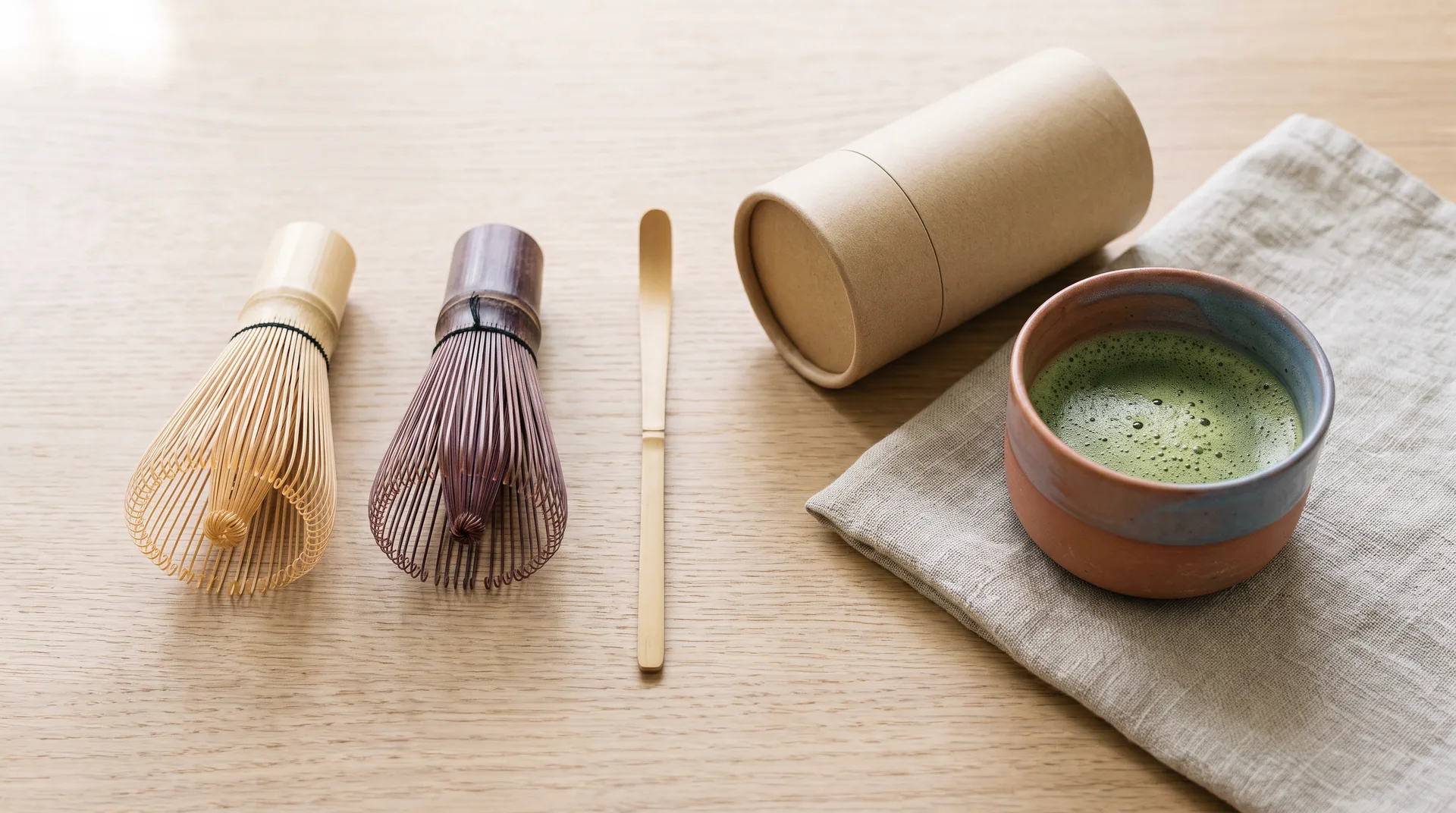
A chasen should be cut from a single piece of bamboo, so that the head, the tines and the handle are one part with nothing glued on. Ask for the bamboo colour and how the whisk is made. Our chasen are cut from one piece of bamboo, in white or purple bamboo depending on the model.
The colour changes the look and, slightly, the weight. Our 100-prong whisk in purple bamboo, GTG201013, weighs about 70 g, and the GTG201001 about 50–55 g. Both are about 115 mm tall with a base about 30 mm across.
A sample settles what a description cannot: how evenly the tines curl, how tight the thread at the base is, and how the handle sits in the hand.
5. How is each whisk packed, and what is in a carton?
Packaging decides how a chasen survives the post and how it looks on a shelf. Ask for the unit pack, the number of whisks per carton, and the carton's size and weight. The GTG201001 ships in a plastic tube, or in a paper tube for EUR 0.50 more, 25 to a carton of 300 × 300 × 110 mm at about 1.55 kg.
The carton figures matter for your own shipping. They tell you how many whisks fit on a shelf, how much a parcel weighs and when a pallet becomes cheaper than courier parcels.
A shop that sells the whisk on its own needs a tube or box that protects the tines. A gift-set maker needs the whisk loose or in a size that fits the set's box, so ask for both options before ordering.
6. Who is the EU importer, and is it named on the product?
Since 13 December 2024, a product may be placed on the EU market only if an economic operator established in the EU is responsible for it. Ask the supplier who that operator is. For chasen bought from our stock, Global Trade Group in Warsaw is the EU importer; for chasen you import yourself, you are.
The rule is Article 16 of the General Product Safety Regulation (EU) 2023/988, the GPSR. Article 11 adds that an importer must put its name and postal and electronic address on the product, or where that is not possible on its packaging or in an accompanying document.
An online store has one more duty. Under Article 19, an online offer must show the manufacturer's name and address, the responsible person in the EU when the manufacturer is outside it, a picture and the type of the product, and any warning or safety information. Ask the supplier for these details before you list the whisk. Our EU import compliance page covers the importer's duties in more detail.
7. What do the food-contact rules require for a chasen?
A chasen touches the matcha it whisks, so it falls under Regulation (EC) No 1935/2004 on materials in contact with food. The regulation requires that the whisk does not pass its constituents into food in quantities that could endanger health, and that each batch can be traced. Ask how the bamboo is finished and how a delivery is traced.
Regulation (EC) No 1935/2004 applies to materials and articles intended to be brought into contact with food (Article 1). Article 3 sets the general requirement: under normal use, a material must not transfer its constituents to food in quantities that could endanger health, change the food's composition unacceptably, or spoil its taste or smell.
Traceability, under Article 17, means every business in the chain can name the business it bought from and the business it sold to. Keep the supplier's invoice and the delivery details with your records.
8. Can I test a sample before the bulk order?
You should, and a good supplier expects the question. A sample shows the tines, the binding thread and the handle before money goes into a carton. We send samples before a bulk order on every line: send us the code you want to test and the delivery country, and we reply within one business day.
Whisk the sample with the matcha you will actually serve. A café pouring lattes all day judges a whisk differently from a tea shop selling it to customers for straight matcha.
The checks worth doing on a sample are listed in how to choose a chasen.
9. How will the invoice treat VAT?
Within the EU, VAT on a wholesale order depends on where the buyer and seller are registered. An EU company outside Poland with a VAT number confirmed in VIES buys from our stock in Poland at 0% VAT, under the reverse charge, and a Polish company pays 23% VAT. Ask the supplier to check your number before it invoices.
The rule is Article 138 of the EU VAT Directive. It exempts goods dispatched to another member state when the buyer is a business identified for VAT in that state and gives the supplier its VAT number. The buyer then accounts for the VAT in its own country.
VIES is the EU's register of VAT numbers, and anyone can check a number there. Our order page checks the number in VIES as you enter it, so the VAT on the invoice is settled before you pay.
10. Can you make the chasen under my brand, and from how many pieces?
Private label means the whisk is sold under your brand: your name, logo, label and packaging. Ask for the minimum quantity and the delivery date before you design anything. For the GTG201001 chasen, our private label starts at 1,000 pieces and is quoted to your specification.
A paper tube can replace the standard plastic tube, and the private-label matcha accessories page shows what else can carry your mark. The price ladder and what a shop earns on each whisk are worked through in chasen wholesale: prices, shop margin and private label.
Where we stand on each of the ten questions, from stock to VAT, is summed up in our post on the chasen supplier in Europe. Our sales team answers anything else on WhatsApp, by email and by phone.