
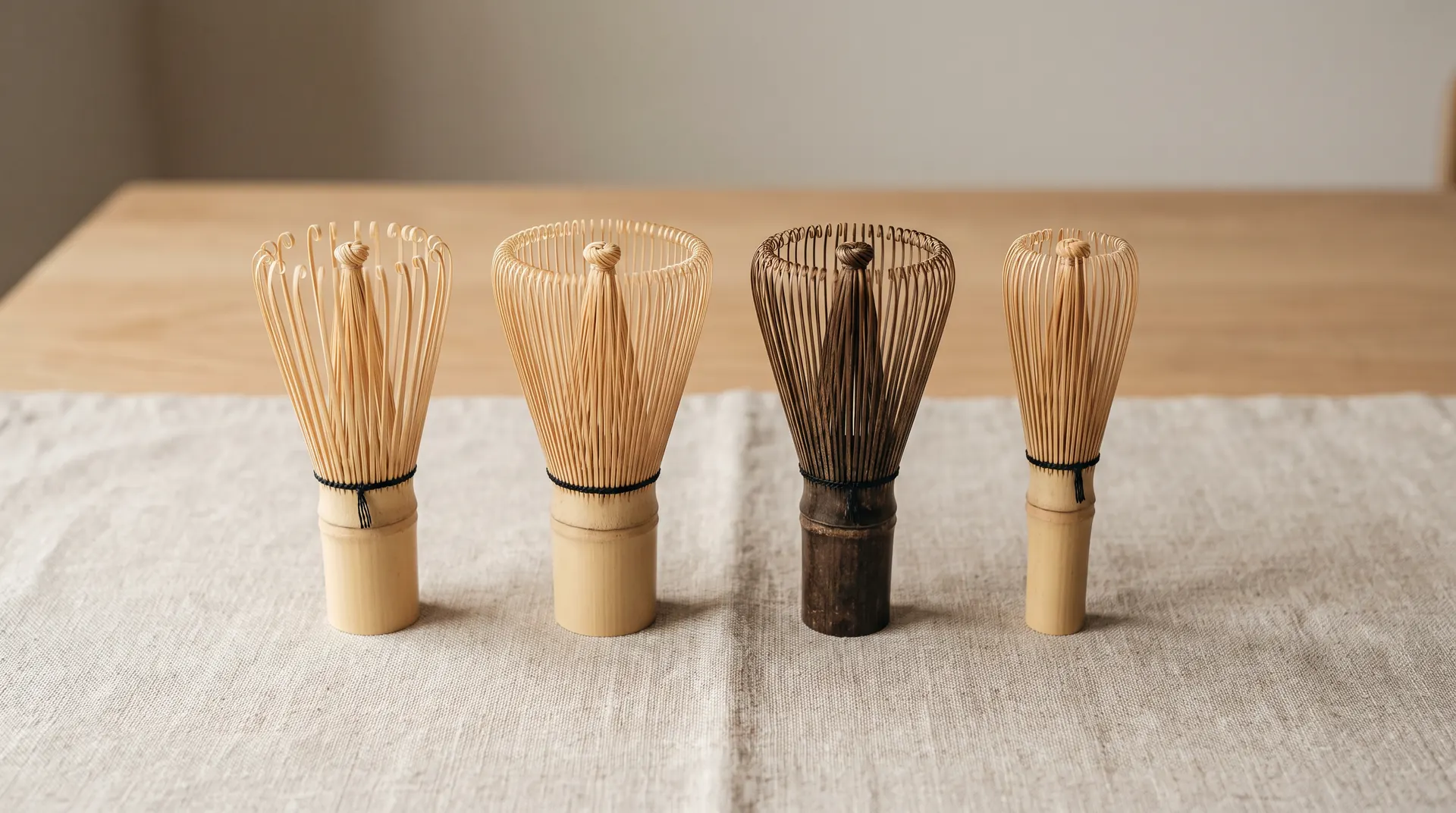
What is a chasen (bamboo matcha whisk)?
A chasen is a bamboo matcha whisk: one piece of bamboo split into dozens of thin prongs, sometimes over a hundred, bound with thread. The chasen disperses matcha powder in water without lumps and aerates the tea into a thick, fine foam. A fork or a milk frother does not give the same result.
Tezumi, a specialist Japanese tea shop, says the whisk turns matcha into a frothy usucha or kneads it into a thick koicha. Usucha (thin tea) is matcha whisked with more water into a light foam. Koicha (thick tea) is matcha worked with little water into a smooth paste.
In a café, the chasen whisks usucha served in a chawan, the wide matcha bowl. It also whisks a matcha shot with a little water before the milk goes in.
How many prongs should a chasen have?
For a shop or a café, choose a chasen with 70–100 prongs. According to the Japanese tea shop Yunomi, about 70 prongs is the standard and most common count, and 80–100 is recommended for beginners. More prongs mean thinner prongs and easier foam, while fewer prongs are thicker and sturdier, for koicha.
The count on the label is approximate: Tezumi notes it usually refers to the outer prongs and rarely matches the real number. Treat it as a class of whisk, not an exact specification.
The most common chasen types, according to Tezumi:
| Chasen type | Prongs (approx.) | Prongs are | Used for |
|---|---|---|---|
| ōaraho | 32 | thick, stiff | koicha |
| chūaraho | 48 | thick, stiff | koicha |
| kazuho | 64–72 | all-round, thin handle | usucha and koicha |
| hachijūpondate | 80 | thinner, easier foam | usucha |
| hyakupondate | 100 | thinner, wider head | usucha |
| hyakunijūpondate | 120 | thinnest, widest head | usucha |
Tezumi calls kazuho the standard in Japan and an all-round whisk for frothy usucha and smooth koicha. Between 80 and 120 prongs, the most noticeable difference in use is the wider head.
The GTG201001 chasen has about 100 prongs, which makes it a hyakupondate, the 100-prong type for usucha, and within the 80–100 range Yunomi recommends for beginners. It suits usucha in a bowl and a matcha shot for lattes.
What should you check in the handle and prong shape?
The handle and the prongs come from one piece of bamboo, so more prongs mean a thicker handle. A thin handle is easier to hold, and a wider head foams more easily. Also check evenly curled tips, a tight thread at the base and a smooth handle without sharp edges.
Tezumi adds that the thin kazuho handle is easier to hold than the bulky handle of an 80, 100 or 120-prong whisk.
Tezumi describes three prong shapes:
- Standard. Straight prongs with a gentle curve near the top and tips curled into a loop. Most chasen have this shape, kazuho included.
- Shin. A narrower handle and more gracefully curved prongs, with no loops at the tips. Tezumi finds the choice between standard and shin mainly aesthetic.
- Straight. One of the oldest styles and uncommon today. The wider head has less room in the bowl, so this chasen is harder to use.
The Japanese tea company Ippodo explains that the curled tips are a decorative finish that also protects the prongs before first use. The tips straighten with use, and that is not a defect.
Ippodo also explains handle cracks: the bamboo is split into prongs, so the handle always has lengthwise splits. A black thread binds the inner and outer prongs, so a cracked handle still works.
Bamboo, silicone or an electric frother?
For straight matcha, whisked with water only, choose a bamboo chasen: it gives a denser foam and finishes sooner. A silicone or plastic whisk lasts longer and survives the dishwasher, so it suits lattes and a busy bar. An electric frother breaks up the powder but makes no fine foam, so it cannot replace a chasen.
A silicone chasen is a chasen-shaped whisk made of silicone or another plastic, such as polypropylene. An electric frother is a device with a spinning head, designed for frothing milk.
| Feature | Bamboo chasen | Silicone or plastic whisk | Electric frother |
|---|---|---|---|
| Foam in straight matcha | dense, fine | thinner, larger bubbles | bubbles instead of a dense foam |
| Time in the Tealife test | about 27 s | about 33 s | not tested |
| Cleaning | warm water only, no detergent or dishwasher | detergent and dishwasher allowed | – |
| Contact with milk | can take on an odour | can whisk heated milk | made for milk |
| Lifespan | wears out; replace when many tips break | several years with good care | – |
The times come from a test by the Singapore tea company Tealife. Over repeated runs, bamboo finished 5–10 seconds sooner than plastic and gave a denser foam. Once milk, sugar or syrup went in, the difference stopped mattering, so Tealife recommends plastic for lattes and busy service.
Ippodo's polypropylene whisk is dishwasher-safe and can whisk heated milk. Ippodo's bamboo chasen is washed with water only, because milk can leave an odour in it. The tea company Ooika describes silicone whisks as stiffer, with slightly larger bubbles, but lasting several years.
After testing alternatives from forks to blenders, Ippodo concluded that the chasen is still the best tool for matcha. The instructions of our own brand, ZOI, add that a frother breaks up the powder but leaves bubbles, not a dense foam.
In a café, the menu decides. A bamboo chasen whisks usucha and the matcha shot with a little water before the milk goes in, so the bamboo never touches milk. Matcha tipped straight into milk leaves lumps, so this step stays even for lattes.
Plastic or paper tube?
The tube protects the prongs in transit and on the shelf, but it is not for storing a chasen after use. The GTG201001 chasen comes in a plastic tube as standard. A paper tube costs EUR 0.50 net more per piece and gives a more premium presentation, for example in a gift set.
Ippodo also ships each chasen in a plastic case and warns against storing it there after use, because the bamboo can grow mould. The ZOI instructions say the same about any closed container.
After rinsing, a chasen dries on a kusenaoshi or, without one, upright on its handle with the prongs up. A kusenaoshi is a cone-shaped ceramic stand: the chasen sits on it prongs down, so it dries and keeps its shape. Tell customers this when they buy.
The choice of tube also changes your margin. We convert both options into złoty in Chasen wholesale: prices, shop margin and private label.
GTG201001 in numbers: where does it fit?
The GTG201001 chasen is cut from one piece of bamboo, with about 100 prongs and a height of about 115 mm. By prong count it is a hyakupondate, the 100-prong type for usucha. We sell this bamboo matcha whisk wholesale from our warehouse in Poland, from 25 pieces, at EUR 3.50–2.40 net per piece.
| Specification | GTG201001 chasen |
|---|---|
| Material | bamboo, one piece |
| Prongs | approx. 100 |
| Height / base diameter | approx. 115 mm / approx. 30 mm |
| Weight | approx. 50–55 g |
| Packaging | plastic tube; paper tube +EUR 0.50 per piece |
| Wholesale carton | 25 pieces, 300 × 300 × 110 mm, approx. 1.55 kg |
| MOQ | 25 pieces |
| Net price per piece | EUR 3.50 (25–99 pcs), EUR 3.20 (100–499), EUR 2.80 (500–999), EUR 2.40 (1,000–4,999) |
| 5,000 pieces and more | individual quotation |
| Private label | from 1,000 pieces |
| Shipping | from our warehouse in Poland: InPost and DPD in Poland, DHL across the EU, pallets |
MOQ (minimum order quantity) is the smallest batch we sell: 25 pieces, one carton. Prices are net of VAT, and we quote shipping separately by country, quantity and weight.
The GTG201001 chasen fits a matcha shop shelf, an online store, gift sets and a café bar. Full specifications and the quote form are on the product page. The matcha tools category also holds the chashaku bamboo scoop (GTG201002).
A different variant, such as a 100-prong chasen or your own packaging, goes through our sourcing agent in China service. Our team in China looks for the manufacturer, orders samples and watches quality through production.
What should you check on a wholesale sample?
On a wholesale sample, check the prongs, tips, thread, handle, smell and tube, then whisk one serving of matcha. A good chasen soaked for a minute makes a dense, fine foam in 15–20 seconds without shedding prongs. You can ask us for a sample before a wholesale order, as with every line we carry.
- Prongs: dense and even all the way round. Judge evenness, because the prong count is approximate.
- Tips: evenly curled, none broken. Small splinters on a new chasen are common and, according to Tezumi, come off after soaking in hot water.
- Thread: tight and centred. A loose thread is a reason to reject the piece.
- Handle: smooth, without sharp edges. Lengthwise splits are natural in split bamboo.
- Smell: dry bamboo, with no musty smell and no mould spots.
- Tube: closes without pressing on the tips.
The whisking test follows the ZOI instructions: soak the prongs in lukewarm water for a minute. Then add 2 g of matcha and 70 ml of water at 75–80 °C to the bowl. Whisk fast in an M shape for 15–20 seconds, with your wrist low over the bowl.
After the test, rinse the chasen in warm water only, let it dry outside the tube and count any broken tips.
Check several pieces, not one: every chasen is cut from natural bamboo, so small differences in colour and shape are normal. Send the sample and quote request from the GTG201001 product page. We come back with a price and a date within one working day.