
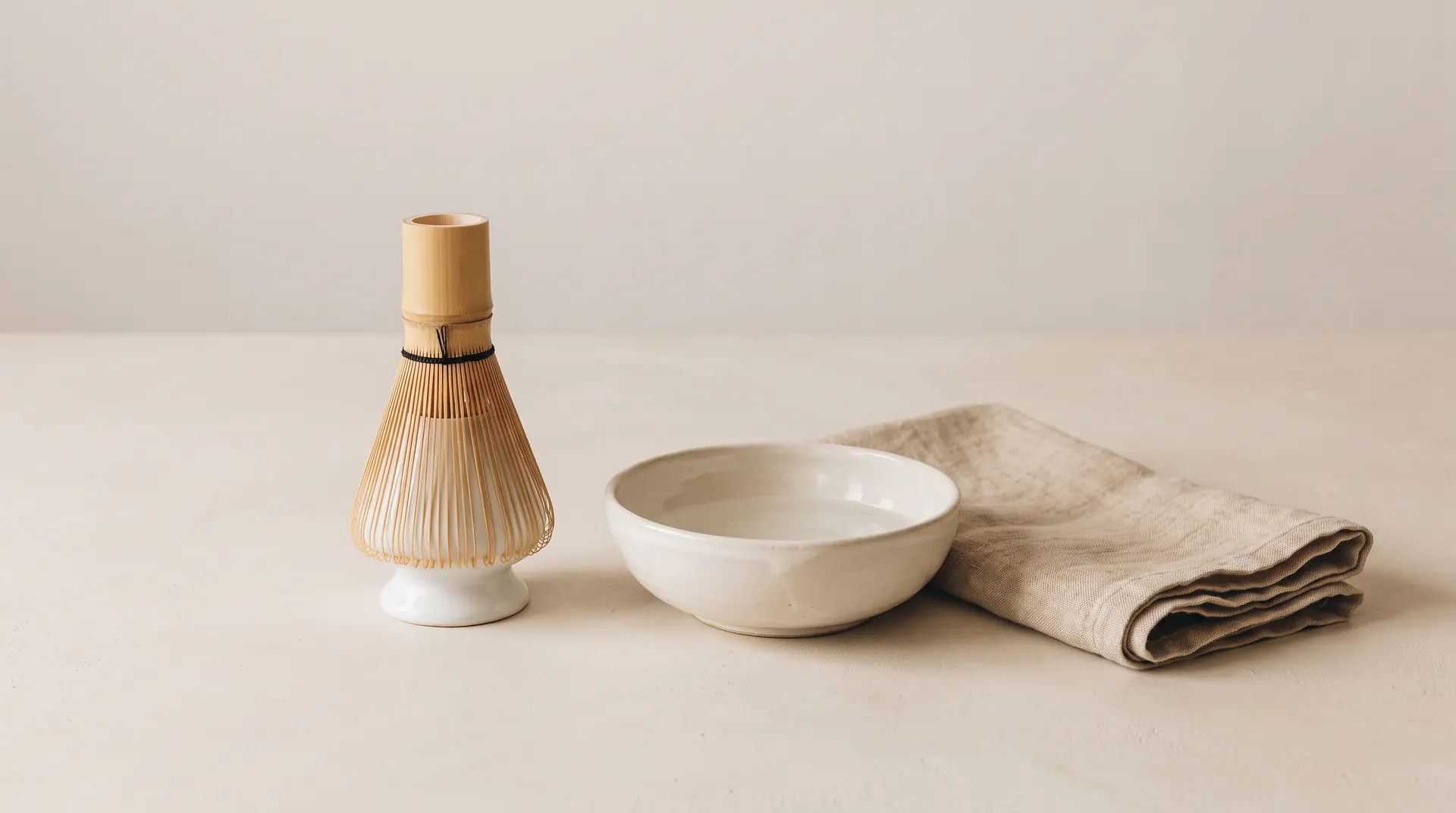
How do you care for a chasen, the bamboo matcha whisk? Soak the tines in lukewarm water for about a minute before whisking, and whisk in a quick M or W motion. After use, rinse the whisk in warm water only and leave it to dry on a kusenaoshi, the ceramic chasen holder.
Never shut a wet chasen away in its tube or a box: damp bamboo grows mould. You will also find a care card here to copy onto a shelf label or parcel insert for your customers.
What is a chasen, and why does it need care?
A chasen is a bamboo matcha whisk cut from a single piece of bamboo, with fine tines at one end. Matcha is finely ground green tea, whisked with water rather than steeped. Dry tines are brittle and damp bamboo shut away from the air grows mould, so a chasen needs a few habits at every use.
Our chasen GTG201001 has about 100 tines, stands about 115 mm tall, has a base about 30 mm across and weighs about 50–55 g. The tines disperse the powder through the water and whisk it into a drink with a thick, fine foam.
No other tool does the job of a chasen. A fork leaves lumps, and a milk frother breaks the powder up but does not aerate it into the same fine foam.
How do you prepare a chasen before whisking matcha?
Before every use, soak the tines of the chasen in lukewarm water for about a minute. Soaked tines soften, become less brittle and do not snap on the first strokes. That is the instruction from our own brand ZOI, and the Kyoto tea company Ippodo recommends soaking for 1–2 minutes (Ippodo chasen care).
The same applies to a new chasen before its first use. Only the tines need to go in the water.
How do you use a matcha whisk without wearing out the tines?
Whisk in a quick M or W motion with your wrist low over the bowl. A circular motion presses the tines against the wall of the bowl and wears them out faster. Whisking matcha with water takes about 15–20 seconds, until a thick, fine foam forms on the surface.
The ZOI recipe for ceremonial matcha: sift about 2 g of powder into the bowl, add 70 ml of water at 70–80 °C and whisk. Never use boiling water, because it burns the matcha and brings out bitterness. A chawan, as the matcha bowl is called in Japanese, is wide with a flat base so the whisk has room to work.
Never whisk milk with a chasen. Ippodo says a chasen is for water and matcha only, and milk for a latte goes in after whisking (Ippodo).
ZOI's latte method: whisk 2–3 g of matcha smooth in 50 ml of hot water first. Then add 200 ml of milk, dairy or plant-based, hot or over ice.
How do you clean a matcha whisk after use?
Clean a matcha whisk straight after use with warm water only, with no washing-up liquid, no sponge and no dishwasher. Rinse the tines, gently remove any powder stuck between them and shake the water off. Ippodo also advises rinsing without soap soon after use and gently removing stuck powder (Ippodo).
The simplest way is to rinse the chasen in the bowl. Pour in warm water and move the whisk through it a few times, as if whisking, then repeat if green residue remains between the tines.
What is a kusenaoshi, and how do you dry a chasen on a chasen holder?
A kusenaoshi is a ceramic chasen holder that keeps the tines in shape while they dry. You stand the wet whisk on it handle up, with the tines over the cone, and leave it to dry in the open air. Without a kusenaoshi, stand the chasen on its handle with the tines up, so the water drains.
Ippodo calls this kind of stand a chasen-tate and says it holds the whisk in shape as it dries (Ippodo).
Honjien, a Japanese tea-utensil shop, adds that a chasen rested on a kusenaoshi lasts longer (Honjien, in Japanese). Honjien also advises drying the whisk somewhere airy and out of direct sun, as bamboo can crack from drying out or sudden temperature changes. So keep your chasen off the radiator.
All four ZOI ceramic sets (Zen, Takumi, Sakura and Kai) include a whisk holder, and the Zen set has a ceramic kusenaoshi. You will find them under matcha sets.
Why does a chasen go mouldy?
A chasen goes mouldy when damp bamboo has no chance to dry. Mould appears when a wet whisk stays in the bowl, goes back into its tube, or ends up in a closed box or drawer. Ippodo warns that leaving a chasen in its case can lead to mould (Ippodo).
We ship the chasen GTG201001 in a plastic tube, or a paper one on request. The tube protects the whisk in transit, but it is a closed container. Put the chasen back only when it is completely dry, and keep it somewhere cool and airy, as Honjien advises.
A café that whisks many times a day should keep several chasen in rotation, so each one can dry. If mould appears on the tines, our advice is simple: stop using that whisk for matcha and replace it.
When should you replace a chasen?
Replace a bamboo chasen when many of its tines are broken and whisking matcha has become harder than it was, as Ippodo advises. Broken tines and a cracked handle cannot be repaired, as the Japanese shop Honjien points out. Replace a whisk with mould on its tines straight away, whatever their condition.
A bamboo chasen is a consumable. A rough lifespan comes from an expert of the Edo Senke school of tea, writing for the Japanese site my-best. With use about once a week, the expert estimates, a chasen is replaced after a few months to about a year.
Check the tines more often if you whisk every day. Care extends the life of a chasen but does not stop the wear. For a shop, the wear is a reason to stock the chasen on its own as well, next to the sets, as a replacement whisk.
How to care for a chasen: what should the customer care card say?
A chasen care card fits into seven short rules. They cover soaking, the M or W motion, milk after whisking, rinsing, drying on a kusenaoshi, never storing it wet, and when to replace it. You can copy the text below onto a shelf label, a parcel insert or a product page.
How to care for your bamboo matcha whisk (chasen)
- Before whisking, soak the tines in lukewarm water for about 1 minute.
- Whisk matcha and water in a quick M or W motion, not in circles.
- Add milk only after the matcha is whisked.
- After use, rinse in warm water only: no detergent, sponge or dishwasher.
- Shake off the water and dry it on a kusenaoshi, or on its handle with the tines up.
- Never leave a wet whisk in the bowl, the tube or a box: damp bamboo grows mould.
- When the tines start breaking or mould appears, replace the whisk.
For a small shelf label: "Chasen: soak before use, rinse with water only, dry on a holder. Never store it wet."
How do you buy chasen wholesale for a shop or café?
You can buy the chasen GTG201001 wholesale from 25 pieces, which is one carton, from our warehouse in Poland. The net price per piece falls from €3.50 at 25–99 pieces to €2.40 from 1,000 pieces. From 5,000 pieces we quote individually, and private label is available from 1,000 pieces.
| Quantity | Net price per piece |
|---|---|
| 25–99 | €3.50 |
| 100–499 | €3.20 |
| 500–999 | €2.80 |
| 1,000–4,999 | €2.40 |
| 5,000+ | individual quote |
A carton holds 25 pieces. The standard pack is a plastic tube, and a paper tube costs €0.50 more per piece. We ship by InPost and DPD within Poland, by DHL across the EU, and on pallets for larger orders.
The goods are already inside the EU, so there is no customs duty or clearance on your side. VAT is settled on our sales invoice, and freight is quoted separately by country, quantity and weight. Details are on the chasen page, and the other tools are under matcha tools.
Tell us on the contact page how many pieces you need and where. We come back with a price and a date within one working day. Accessories outside the catalogue, such as a holder in your own design, we source through our sourcing agent in China service.