
What equipment does a café need to serve matcha?
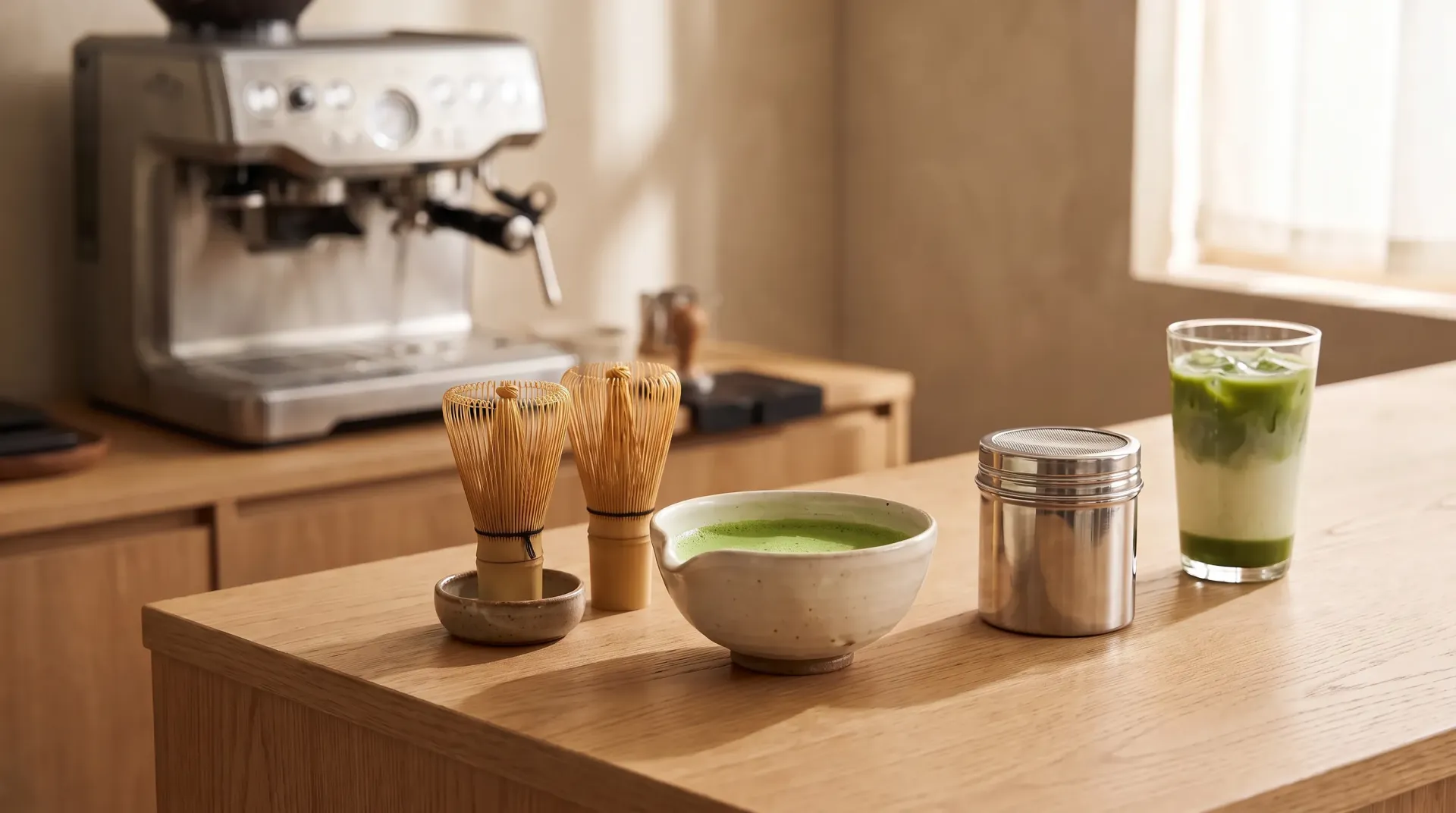
A café matcha station needs six things: a bamboo whisk (chasen), a bowl to whisk in, a holder on which the whisk dries (kusenaoshi), a sifter, a scoop and a scale that reads to 0.1 g. For a menu built on lattes, the bowl should have a pouring spout. A long-handled whisk is the optional seventh tool, for whisking straight in a tall glass.
| Tool | Its job at the station | How many per station | Our code |
|---|---|---|---|
| Bamboo whisk, 100 or 80 prongs | Whisks matcha into a smooth shot with fine foam | 2, used in turn | GTG201001, GTG201004 |
| Spouted bowl (katakuchi) with holder | Bowl to whisk in and pour from; holder dries the whisk | 2 bowls, 1 holder per whisk | GTG203024 |
| Matcha sifter | Breaks up clumps before the water goes in | 1 | GTG201019 |
| Scoop (chashaku) | Lifts matcha from the tin | 1 | GTG201002 |
| Scale, 0.1 g | Weighs the dose so every drink tastes the same | 1 | — |
| Long-handled whisk | Whisks in a tall glass | Optional | GTG201011, GTG201012 |
The 100-prong whisk is the everyday standard and whisks the finer foam; the 80-prong whisk has sturdier prongs that keep their shape longer under heavy use. A café that serves mostly lattes gains more from durability than from the last bit of foam.
How many whisks does a café need?
A café needs at least two bamboo whisks per matcha station, used in turn, so that one dries on its holder while the other works. A bamboo whisk left wet in a cup, a tube or a drawer goes mouldy, and a café that whisks many times a day gives each whisk no time to dry unless it has a second one.
Keep spare whisks in stock as well. A bamboo whisk is a consumable: Ippodo advises replacing it when many prongs are broken and whisking has become harder. An expert of the Edo Senke school of tea, writing for my-best, puts the life of a whisk used about once a week at a few months to a year, so a whisk used dozens of times a day lasts far less. The signs of wear are listed in How to care for a chasen.
The 100-prong whisk is the one tool with published prices: €3.50 net per piece from 25 pieces, one carton, falling to €3.30 from 250. The current prices are on the chasen product page.
Chasen, frother or shaker for matcha lattes?
For lattes, a café can use a frother or a shaker for the milk, but the matcha itself is best whisked with a chasen in a little water first. A bamboo whisk turns the powder into a smooth shot with fine foam; a frother breaks the powder up but leaves bubbles, not foam, and matcha tipped straight into milk leaves lumps.
A resin or silicone whisk is the alternative for a busy bar. In a test by the Singapore tea company Tealife, bamboo whisked a bowl in about 27 seconds and plastic in about 33, with a denser foam from bamboo. Once milk or syrup went in, the difference stopped mattering. The comparison is set out in full in How to choose a chasen.
Keep the bamboo whisk away from milk. Ippodo washes its bamboo chasen with water only because milk can leave an odour in the bamboo.
How should a matcha station be laid out?
A matcha station works in the order of the drink: tin, scale, sifter, bowl, hot water, whisk, glass, then the rinse and the holder. Laid out left to right, or right to left, in that order, nobody crosses the bar to make one drink.
Keep the matcha tin closed between drinks and away from the steam of the espresso machine; matcha clumps as it takes up moisture. Keep hot water at 70–80 °C within reach; Ippodo cools boiling water to 80 °C before it touches the matcha. Put the whisk holders where the whisks can dry in the open air, not in a closed cupboard.
A busy café can sift the shift's matcha in one batch at opening instead of dose by dose, as explained in Matcha sifter: why and how to sift. A café that scoops instead of weighing can calibrate its scoop once, as shown in How many grams is a chashaku scoop?
How much matcha does a café use?
A matcha latte takes 2–3 g of matcha, so a 1 kg bag makes about 330 to 500 lattes. A café selling 30 matcha lattes a day uses 60–90 g a day, and one bag lasts it about 11 to 17 days.
| Lattes a day | Matcha a day, at 2–3 g | A 1 kg bag lasts |
|---|---|---|
| 20 | 40–60 g | 17–25 days |
| 30 | 60–90 g | 11–17 days |
| 50 | 100–150 g | 7–10 days |
The dose decides the cost of every drink, which is why a café weighs it. Culinary matcha (GTG202002) is made for lattes and keeps its flavour and colour in milk; ceremonial matcha (GTG202001) is for matcha served with water. Both come from Japan in 1 kg bags, as compared in Matcha for cafés.
How do you keep the equipment hygienic?
Rinse the bamboo whisk in warm water after each drink, without detergent, and stand it on its holder; never leave it in the bowl or put it in the dishwasher. Wipe the scoop dry. Tap the sifter out and keep it dry, because a damp mesh turns matcha into paste.
The ceramic bowls are washed between drinks like any cup. At closing, the whisks go on their holders in the open air overnight and back into use only when they are dry.
How does a café order its matcha equipment?
A café can order the whisks, bowls, sifters, scoops and matcha from one supplier in one quotation. We supply them wholesale from our warehouse in Poland and ship by courier: InPost and DPD within Poland, DHL across the EU, and pallets for larger orders.
The goods are already inside the EU, so there is no customs duty or clearance on your side. A Polish company pays 23% VAT; a company in another EU country with a VAT number confirmed in VIES buys at 0% VAT under the reverse charge. Send the codes, the quantities and the delivery country, and we reply within one business day. The whole range is listed in Matcha accessories wholesale in Europe.